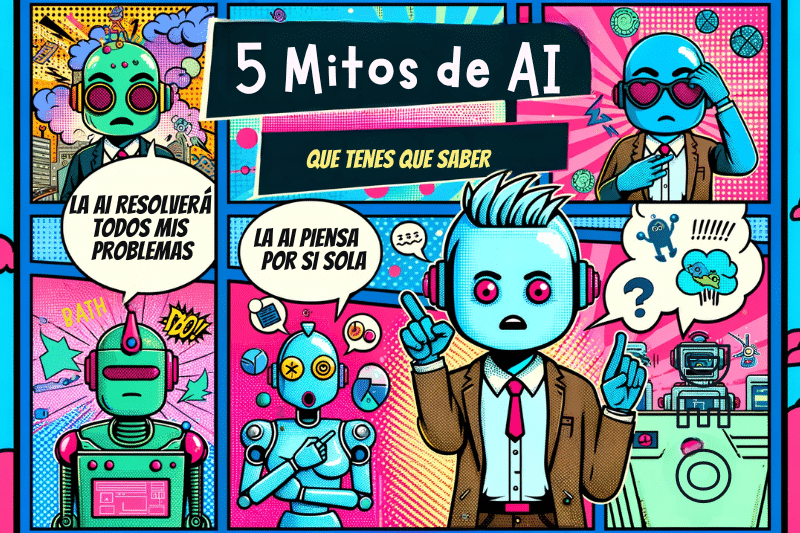
Why do these myths continue to circulate?
Every time a new transformative technology emerges, two extreme camps appear: those who promise utopia and those who announce the apocalypse. The same thing is happening with artificial intelligence. Sensationalist headlines generate more clicks than nuanced reality, and myths spread faster than data.
The problem is that believing in these myths has real consequences: professionals avoiding AI out of fear, companies implementing it expecting miracles, and people distrusting tools that could improve their productivity. Let's separate fiction from reality.
What you need to know in 30 seconds
According to the Future of Jobs Report 2025 from the World Economic Forum, AI will create 170 million new jobs and will displace 92 million by 2030, resulting in a net increase of 78 million jobs. AI is not your enemy: it's a tool you need to learn to use.
The 7 Artificial Intelligence Myths You Need to Stop Believing
Myth 1: AI will replace ALL jobs
Reality AI is transforming roles, not eliminating them en masse. The WEF projects 78 million net new jobs by 2030. The most in-demand jobs include data specialists, fintech engineers and AI experts — but also educators, care workers and delivery drivers.
Myth 2: AI thinks like a human
Reality AI has no consciousness, emotions, or genuine understanding. It detects statistical patterns in massive datasets and generates probabilistic responses. It doesn't “understand” what it's saying: it predicts the most probable next word in a sequence.
Myth 3: AI is always right
Reality AI models “hallucinate” regularly: they invent data, quotes and even URLs that do not exist. The quality of their responses depends directly on the quality of the data they were trained on. You should always check the information..
Myth 4: AI is only for technical people
Reality In 2026, tools like ChatGPT y Claude They work using natural language. You don't need to know how to program to use them. Teachers, doctors, lawyers, designers, and entrepreneurs use them daily for everyday tasks.
Myth 5: AI will become conscious (Terminator style)
Reality Artificial General Intelligence (AGI) does not yet exist. Current systems are “narrow” AI: excellent at specific tasks, incapable of autonomous general reasoning. Humans design, train, and can switch off any AI system at any time.
Myth 6: AI content can always be detected
Reality AI detectors have significant error rates. Studies from 2026 show that they are particularly unreliable with advanced models such as GPT-4 and GPT-5, sometimes misidentifying human-written text as AI-generated. No detection tool is 100% reliable.
Myth 7: Free AI tools aren't any good
Reality In 2026, the free versions of ChatGPT, Claude, and Gemini they access the same advanced models as the paid versions, just with tighter usage limits. For moderate use, the free tools are genuinely useful and powerful.
Myth vs. Reality: Complete Comparison Table
| Myth | What people believe | The reality in 2026 |
|---|---|---|
| 💼 Total job replacement | “Robots are going to take all our jobs.” | The WEF forecasts a net increase of 78 million jobs. 85% companies are already offering AI training to their teams. |
| Human thought | “ChatGPT understands what I say” | AI processes statistical patterns. It has no emotions, motivations, or real understanding of language. |
| Infallibility | “If AI says so, it must be true” | Hallucinations are frequent. Fabricated data, false sources, and logical errors occur regularly. |
| 💻 For technicians only | “You need to know how to program.” | Conversational interfaces have removed that barrier. You write in Spanish, the AI responds in Spanish. |
| 🤖 Consciousness / Terminator | “We're about to create Skynet” | AGI doesn't exist. Current systems are specialised tools under total human control. |
| 🔍 Infallible detection | “You can always tell if something was written by an AI.” | Detectors fail with new models and generate false positives in human text. They are not 100% reliable. |
| 🎁 Free tools = useless | “If you don't pay, it doesn't work” | The free plans for 2026 use the same models as the paid ones, with reasonable usage limits. |
How to think correctly about artificial intelligence
The correct analogy: Think of AI as an advanced calculator for language and reasoning. A calculator doesn’t “understand” maths, but it helps you solve problems faster. In the same way, AI doesn’t “think”, but it amplifies your ability to work. The professional who uses AI is not replaced by AI — is replaced by another professional who does use it.
Instead of asking “Is AI going to replace me?”, the correct question is: “How can I use AI to be better at what I do?”. According to the World Economic Forum, 77% of global employers are already offering AI training to their teams. The trend is clear: AI is a productivity tool, not a replacement for humans.
Real concerns you SHOULD take into account
Debunking myths doesn't mean ignoring real risks. These are legitimate concerns that deserve attention.
- Algorithmic bias AI models inherit biases present in their training data. This can lead to real discrimination in job selection processes, financial credit, and criminal justice.
- Data Privacy Every time you input personal information into an AI tool, that data could be used for future training. Always read the privacy policies before sharing sensitive data.
- Deepfakes and misinformation The ability to generate ultra-realistic images, audio, and video makes it easier AI scams and disinformation campaigns on a large scale.
- Over-dependence Using AI as a crutch without checking its answers can impair your critical thinking and independent analysis skills.
- Skills gap The WEF warns that although 170 million new jobs will be created, they will not be in the same places or for the same people who lose the 92 million displaced. Retraining is urgent.
Preguntas frecuentes sobre los mitos de la IA
Will artificial intelligence take my job?
It is unlikely that AI will completely replace your job, but it is likely to transform it. According to the World Economic Forum (2025), 78 million net new jobs will be created by 2030. The key lies in adapting: 41% of global companies plan to reduce their workforce in areas that can be automated, but 85% already offer training in AI. Professionals who learn to use AI as a tool will have a competitive advantage.
Do ChatGPT and Claude truly understand what I'm saying?
Not in the human sense. Language models process statistical patterns from billions of texts. They predict the next most probable word in a sequence, which produces responses that They look understanding, but there's no genuine comprehension, emotion or intent behind them. You can compare them to A very capable virtual assistant but without self-awareness.
Can I trust what artificial intelligence says?
With caution. AI is an excellent productivity tool, but it frequently “hallucinates”: it invents data, quotes, and sources that do not exist. You should always check the critical information independently, especially when it comes to statistical data, medical or legal recommendations, and specific historical facts.
Is it dangerous for AI to become more intelligent?
The real risks don't come from a “conscious superintelligence” (that doesn't exist), but from how we use current AI: algorithmic biases that discriminate, deepfakes that deceive, and excessive reliance that atrophies critical thinking. The danger isn't that AI will think for itself, but that humans will use it irresponsibly or without adequate supervision.
Are free AI tools really worth it?
Yes. In 2026, the free plans for ChatGPT, Claude and Gemini will access the same advanced models as the paid plans, only with more restrictive message limits. For moderate use — occasional queries, writing, brainstorming, basic analysis — the free versions are more than sufficient. You only need the paid version if you use AI intensively on a daily basis. Read our Comparison: Claude vs ChatGPT to choose the best option.
Do you want to learn how to use AI effectively and safely? Explore our practical guides.
Discover how to use ChatGPTLast updated: March 2026. The data in this article comes from the Future of Jobs Report 2025 from the World Economic Forum, academic research on AI content detection published in 2025-2026, and an analysis of the AI tools ecosystem available in March 2026.
 EN
EN  ES
ES  PT
PT  DE
DE  FR
FR